AI that understands the space it has to move through.
A machine can recognise a pallet, a person and a puddle. What it rarely knows is what they mean on this site: which zone belongs to people, which doorway takes one unit, and when the right move is to stop and ask. Recapi builds that layer.
WHERE RECAPI CAN HELP
Six areas of work where Recapi has already closed the gap.
Each is a part of operating in the physical world where the model is fine and the site knowledge is missing. These are the ones where we built the understanding.
01 · SCENE UNDERSTANDING
Recapi turned recognition into what it means here
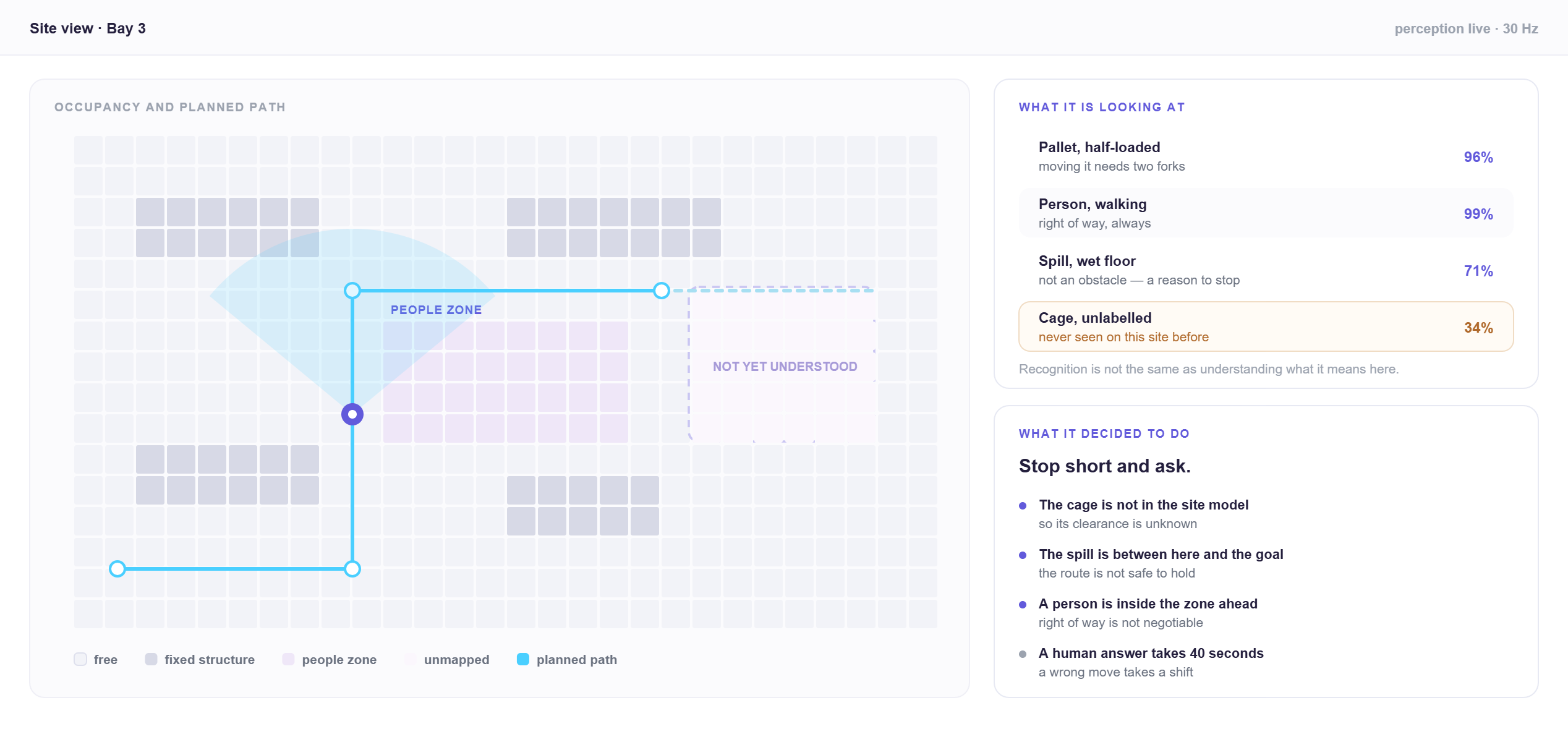
Objects, zones and fixed structure were held as a site model rather than per-frame detections, so a puddle became a reason to stop, a zone became something people own, and anything outside the model was marked unknown instead of guessed at.
02 · PERCEPTION IN CONTEXT
A confident label was still allowed to be unclear
What the machine had never seen on this site was flagged, not forced into the nearest class.
03 · TASK & MOTION PLANNING
Routes respected rules that are not on any map
Shorter paths were rejected because they crossed a zone the site reserves for people.
04 · KNOWING WHEN TO STOP
Stopping and asking became a correct outcome
Forty seconds of a human answer against the cost of one wrong move.
05 · SITE KNOWLEDGE
Every site kept its own quirks
Blind corners, washdown timing and doorway limits treated as constraints.
06 · FLEET LEARNING
One human answer taught the whole fleet at once
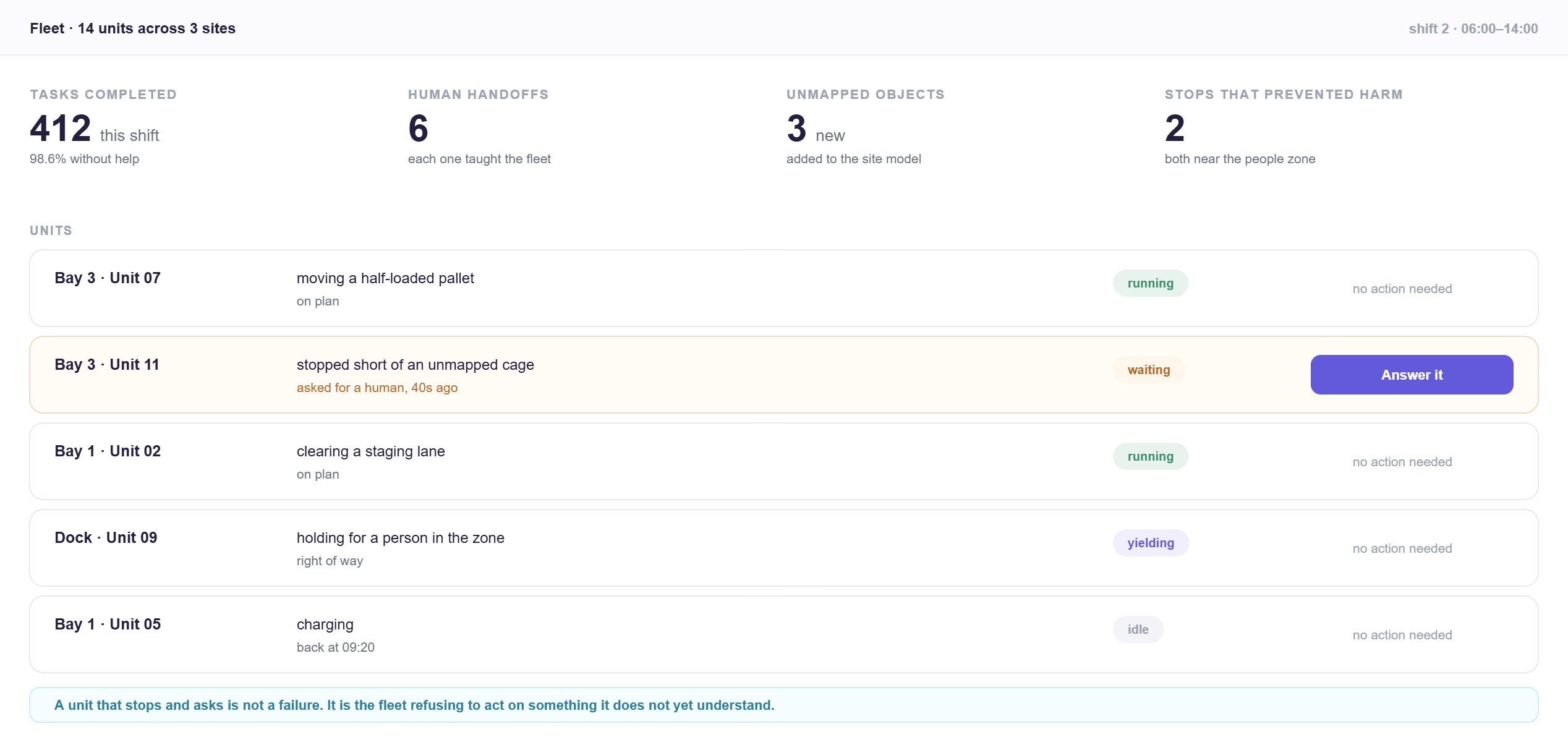
When a unit stops and a person answers, that answer becomes part of the site model rather than a note in one machine’s log, so the next unit routes past the same object without stopping and the same question is never asked twice.
HOW WE WORK WITH YOUR BUSINESS
We start with your workflow, not with our product.
We walk the site with the operators and supervisors who know what the map does not say: where people cut through, which surface goes slick, and what a machine should never do near the dock. Only then do we decide what intelligence is worth building.
Nothing gets built until we can explain how your work actually happens.
01
Understand how it works
Walk the site as it actually runs, not as the layout drawing shows it.
02
Find where intelligence is missing
Name the moments a machine would act confidently and be wrong.
03
Build the understanding
Turn site rules, operator knowledge and history into a model it can reason over.
04
Deploy into the workflow
Into the fleet and the supervisor’s screen, not a separate console.
05
Keep improving it
Every stop and every answer updates the site model.
WHAT AI CAN ACTUALLY TAKE ON
Four things that only work once it understands the site.
Say what it is looking at, in this site’s terms
A label is the easy half. What that object means here - who owns the space, what it blocks, what it is rated for - is the half that has to be built.
Plan a route around rules that are not on the map
Two shorter paths rejected because they crossed a zone the site reserves for people, with the trade-off stated rather than hidden.
Know when the right move is to stop and ask
An honest unknown beats a confident mistake. The machine holds position, states what it cannot resolve, and asks a question a person can answer in seconds.
Teach the whole fleet from one answer
What one unit learns at a blocked aisle becomes part of the site model, so the next unit routes past it without stopping.
WHAT WE'VE ALREADY BUILT
This is how it behaves on a real floor.
We built intelligence that holds a site as a model rather than a map: who owns which space, what each surface does, which openings take one unit, and what a machine should do when something is genuinely unfamiliar.
It is not a demo and not a template. It is what happens when Recapi learns a domain properly.
Site-specific
The same fleet behaves differently because each site does.
Honest unknowns
A stop is a decision, and the answer to it is kept.
PRODUCT GLIMPSES
Three places the understanding shows up.
Screens from the system in production. Data shown is illustrative.
ONE WORKFLOW IS JUST THE BEGINNING
Warehouse floors are where we started. They are not the boundary.
The same approach applies wherever a machine has to act in a space that people already share and already have rules for. These are the next places it fits.
INTRALOGISTICS
Already built
Site model, planning and handoff, running on real floors.
MANUFACTURING
Cells that know their line
Tooling, tolerances and changeover treated as part of the task.
INSPECTION
Faults judged in context
What counts as a defect differs by asset, age and duty.
AGRICULTURE
Fields that change weekly
Ground conditions and crop stage as constraints, not noise.
CONSTRUCTION
Sites that move every day
A model that expects the layout to be different tomorrow.
FACILITIES
Shared space, human first
Machines that yield because the rule says so, not because a sensor fired.
What we built here is one example of what becomes possible when Recapi enters a complex domain and learns how the work actually happens.