AI that understands how a workforce actually runs.
Demand, skills, leave, policy and cost all decide the same roster, and most of what resolves them lives with the manager who builds it. Recapi builds the domain understanding AI needs to operate inside that work, from forecast to published shift.
WHERE RECAPI CAN HELP
Six areas of work where Recapi has already closed the gap.
Each is a working discipline with its own rules and dependencies. These are the ones where we built the understanding and watched the work change.
01 · DEMAND & ROSTERING
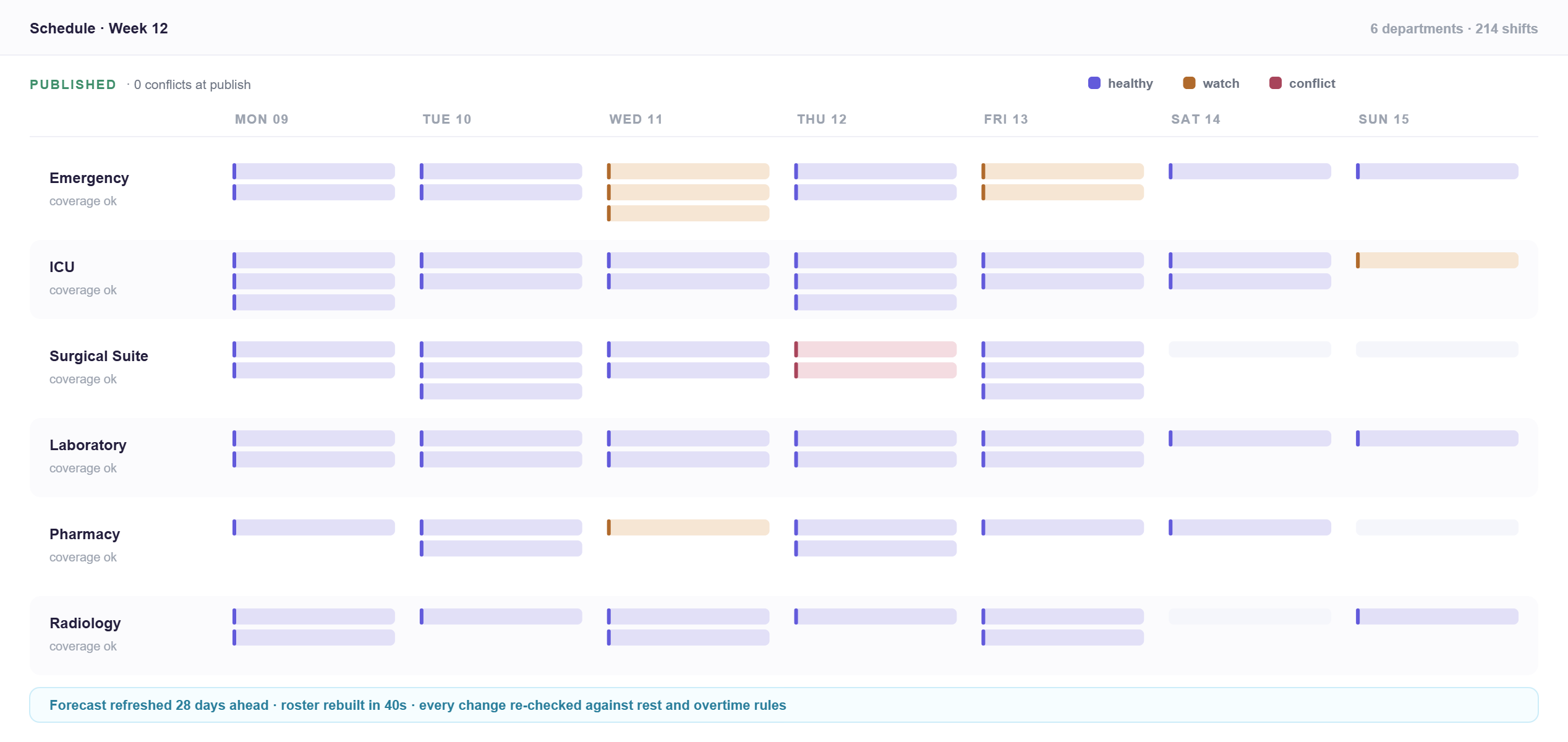
Recapi read the demand and built the roster from it
History, events, skills and policy were taken as one model rather than four spreadsheets, so coverage, rest gaps, cost and skill mix were all resolved in the same pass instead of being reconciled afterwards.
02 · SHIFT OPERATIONS
A sick call stopped costing a morning of phone calls
Move one person and the shift, the cover and every affected rule were re-resolved together.
03 · POLICY & COMPLIANCE
The organisation's own rules became the constraint
Rest gaps, caps and union limits read once, then applied on every rebuild.
04 · SKILLS & CERTIFICATION
Who is qualified, not only who is free
Certifications, expiries and supervision requirements sat inside the assignment itself.
05 · LEAVE, SWAPS & REQUESTS
Requests answered against the whole roster
Leave, swaps and preferences checked for knock-on effects before anyone approves them.
06 · WORKFORCE KNOWLEDGE & COST
The reasoning managers carry in their heads became something the system holds
Who works well together, which pairings to avoid, what a site does when it floods - the judgement that never reaches a policy document was captured and applied, and every roster carried its own cost and overtime position as it was built.
HOW WE WORK WITH YOUR BUSINESS
We start with your workflow, not with our product.
We sit with the schedulers, supervisors and site managers who hold the reasoning nobody wrote down. Only then do we decide what intelligence is worth building.
Nothing gets built until we can explain how your work actually happens.
01
Understand how it works
Sit with the roster as it is actually built, not as the policy describes it.
02
Find where intelligence is missing
Name the calls that depend on knowledge no system holds.
03
Build the understanding
Turn demand, policy and expertise into structure AI can reason over.
04
Deploy into the workflow
Into the board the team already opens, not a portal beside it.
05
Keep improving it
Every published week teaches it something the last one didn't.
WHAT AI CAN ACTUALLY TAKE ON
Four things that only work once it understands the domain.
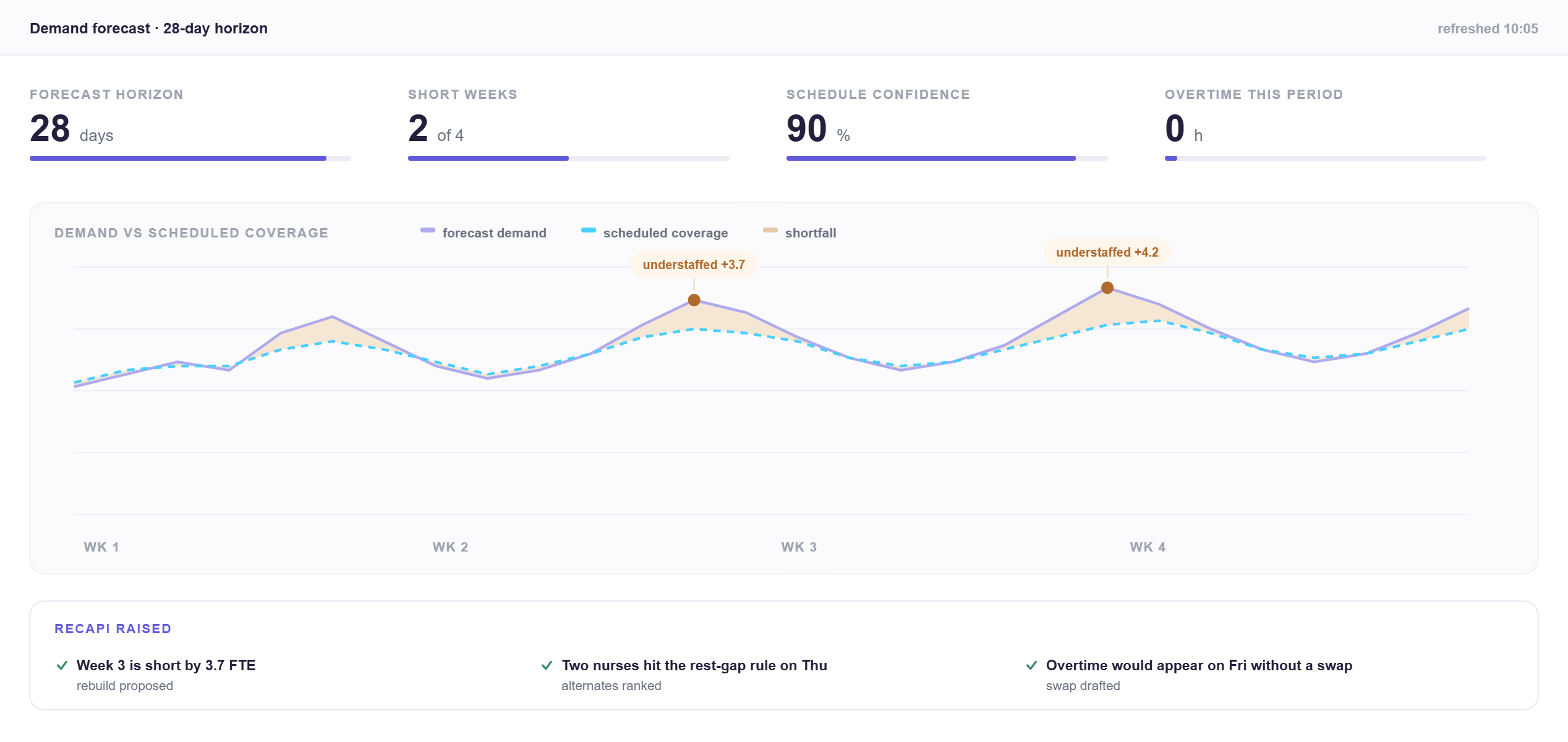
See the short week before it happens
Demand forecast against scheduled coverage across a 28-day horizon, with the shortfall named in people rather than percentages.
Build a roster that respects every rule at once
Rest gaps, overtime caps, certifications, leave and union limits resolved in the same pass, not checked afterwards.
Rank cover in seconds, not phone calls
When a shift opens, candidates are ordered on rest gaps, certification, overtime headroom and history - not on who picks up first.
Answer a scheduling question with its reasoning
Ask who can cover, what a swap costs or why someone was skipped, and the answer carries the rules it used.
WHAT WE'VE ALREADY BUILT
This is already running on live rosters.
We went deep into shift-based operations and built intelligence that forecasts demand, builds the roster around it, and reworks the day when someone calls in - with every rest gap, cap and certification held as a constraint rather than a later check.
It is not a demo and not a template. It is what happens when Recapi learns a domain properly.
Demand-first
The forecast drives the roster, not last month's template.
Rules as inputs
Policy shapes the schedule instead of failing it afterwards.
PRODUCT GLIMPSES
Four places the understanding shows up.
Screens from the system in production. Data shown is illustrative.
ONE WORKFLOW IS JUST THE BEGINNING
Shift rostering is one domain we went deep into. It is not the boundary.
The same approach applies wherever people, skills and demand have to be reconciled under rules. These are the next places it fits.
ROSTERING
Already built
Forecast to published shift, running on live rosters today.
HIRING
Headcount tied to real demand
Open roles argued from the coverage gap the forecast keeps producing.
ONBOARDING
Ramp that knows the site
New joiners scheduled against supervision requirements, not just availability.
TRAINING
Skills built where cover is thin
Certification planned against the shifts the roster struggles to fill.
PAYROLL & COST
Cost known before publish
Premiums, overtime and allowances resolved while the roster is still a draft.
FIELD & MULTI-SITE
Travel and sites as constraints
Distance, site rules and handover treated as part of the assignment.
What we built here is one example of what becomes possible when Recapi enters a complex domain and learns how the work actually happens.